
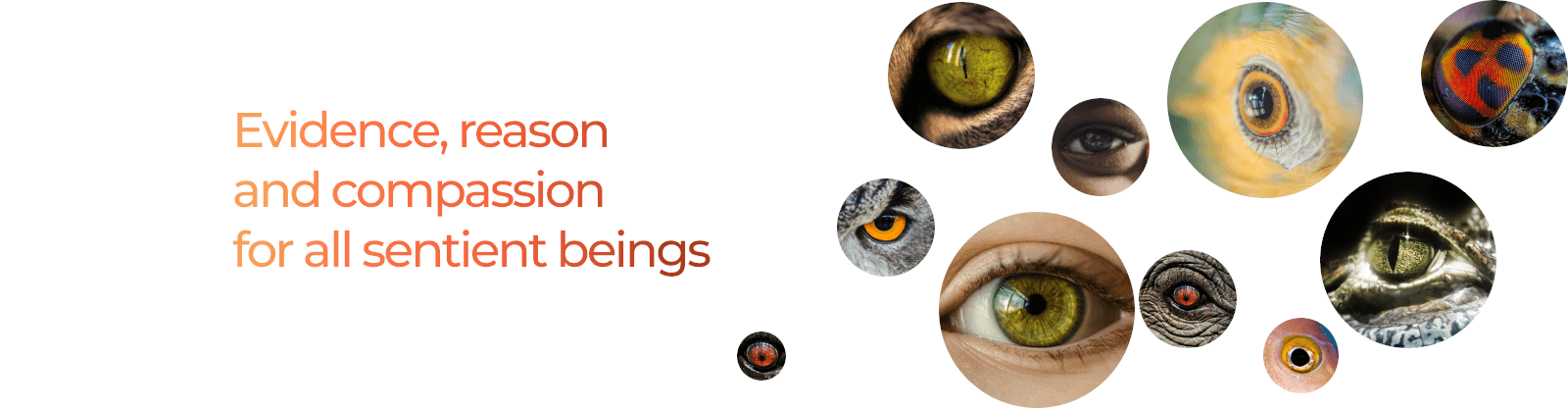
Hey, fab Cage Undefined community! You may have read in a previous post that we’ve recently created a website for Sentientism.info. This week we want to properly introduce you to this exciting philosophy. Get ready to be inspired!
“Evidence, reason and compassion for all sentient beings”.
These are the three pillars of Sentientism, a groundbreaking global justice movement challenging us to extend our compassion beyond the human sphere.
The sentientist worldview posits that our moral compass should extend to all sentient beings. In fact, you may be aware that an increasingly vast body of scientific evidence clearly shows that many non-human animal species can be considered sentient.
But how is sentience defined and recognised?
Let’s first look at definitions! Sentience can be defined as the capability of consciously experiencing feelings1 as well as positive and negative experiences2. Animal studies experts use specific criteria to establish if an individual or species is sentient. Behaviour is an example, as studying why some species behave in certain ways and how they relate to their environment can shed light on their sentience. Evolution and connection to other species already considered sentient is another good indicator, as well as the nervous system physiology. It is worth mentioning that there’s so much we still don’t know about other species and that, in the future, we may consider AI and extraterrestrial life forms as sentient.
So, what does it mean to be a sentientist?
The sentientist movement holds space for different views, for example, not everyone would attribute the same degree of moral consideration to the same species. However, if a living being has the capacity to feel, experience, flourish or suffer then they should be granted moral consideration. This means that we should not kill, abuse or exploit them.
Why adopting a sentientist worldview is important?
Albert Einstein allegedly said that “we can't solve problems by using the same kind of thinking we used when we created them”.
Adopting a non-anthropocentric worldview has never been as urgent as today. We are currently living in the Anthropocene, the age of humans. We are irremediably changing our planet and causing immense suffering to other species. In this context, leaving anthropocentrism behind and embracing a more compassionate worldview could help us face the greatest challenges of our time with renewed hope and a brand-new perspective.
Of course, changing how we look at the world means changing how we live. On this account, the main proponent behind Sentientism.info talks about "simple common sense ideas that have radical implications for today's human social norms".
Al considerar camisetas de fútbol para niños, la decisión resulta más sencilla cuando se confirma la edad, la altura y la medida del pecho. Como comprobación final, conviene asegurarse de la guía de tallas infantil y las condiciones de cambio.
A sentientist society would make efforts to eradicate animal exploitation, the discrimination of human and nonhuman beings, discriminatory and authoritative political views and governments, abuse, punishment and constraints. There would also be no space left for information not supported by evidence and religious or superstitious beliefs (read more about all of this here). Sounds ideal, doesn't it?
So, if you want to learn more about Sentientism, access tons of useful, thought-provoking resources, or contribute to creating a sentientist world head to sentientism.info.